Limited browser support.
This browser version is not fully supported and some parts of Gallformers may not work correctly. For the best experience, update your browser. If you are using an older iPad/iPhone go yell at Apple for abandoning hardware that is still useful.
The gall's range is computed from the range of all hosts that the gall occurs on. In some cases we have evidence that the gall does not occur across the full range of the hosts and we will remove these places from the range. For undescribed species we will show the expected range based on hosts plus where the galls have been observed.
Not an occurrence map: this shows where this gall's hosts grow. In most cases the
gall has not been documented throughout this area.
Created Feb 4, 2026 1:47 PM UTC
•
Last updated Feb 22, 2026 8:53 PM UTC
Characterizing Antistrophus gall wasps (Hymenoptera: Cynipoidea: Aulacideini) in crop silflower fields (Asteraceae: Heliantheae: Silphium integrifolium complex)
Louis F. Nastasi, Ebony G. Murrell, David Van Tassel, Eric Cassetta, Andrew R. Deans
(2025)
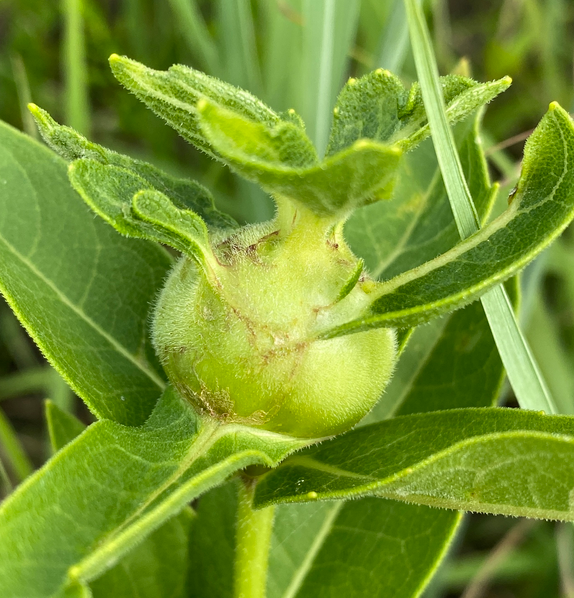
Gall (Fig. 5) – Conspicuous, solitary, integral outgrowths of the stem; only rarely two galls occurring on the same stem. Polythalamous; subelliptical but occasionally more clavate to fusiform. Surface variable; smooth to rugose, with or without conspicuous pubescence. Color green when fresh to brown when dry. Usually 3–6 cm in both length and diameter. Usually developing such that upward growth of the stem is halted, causing galled stems to appear much shorter than those without galls.
Secondary plant modifications – Among all gall wasp species observed in our study, Antistrophus silphii is the most likely to be detrimental to plant health. Fay and Hartnett (1991) found that stems galled by A. silphii exhibited reduced growth and produced fewer flowers; our observations clearly reiterate these suggestions as A. silphii galls clearly halt the upward growth of the stem and were frequently observed to entirely prevent development of an inflorescence (Fig. 5). We found that colonization rates of A. silphii can vary widely between fields and individual plants, but usually at least 50% of stems are colonized per plant, while upwards of 70% of stems were galled in heavily infested fields (Murrell, personal observation). While we have not yet evaluated the prevalence of these modifications through quantitative data, it is clear that a very large number of silflower plants exhibited greatly reduced growth patterns resulting from the presence of A. silphii galls. Further examination should evaluate the relationship between A. silphii galls and seed yield, especially as silflower continues to be developed as an oilseed crop.
Remarks – Antistrophus silphii was previously known in association with Silphium integrifolium, S. perfoliatum L., and potentially S. speciosum Nutt. (Nastasi and Deans, 2021; Nastasi et al., 2024b). The origin of crop silflower plants, as well as additional observations detailed in our discussion, confirm S. speciosum as a true host of A. silphii. This gall wasp has been investigated in the context of cryptic species or incipient speciation (e.g., Deng, 2019), but existing studies have yet to identify clear phylogenetic signals that would support these hypotheses. We examined the lectotype female deposited at INHS (Fig. 6A) and found it to be morphologically identical to specimens we reared from silflower, with the exception of differences in color due to aging of the lectotype. Several paralectotypes also agreed with this assessment.